
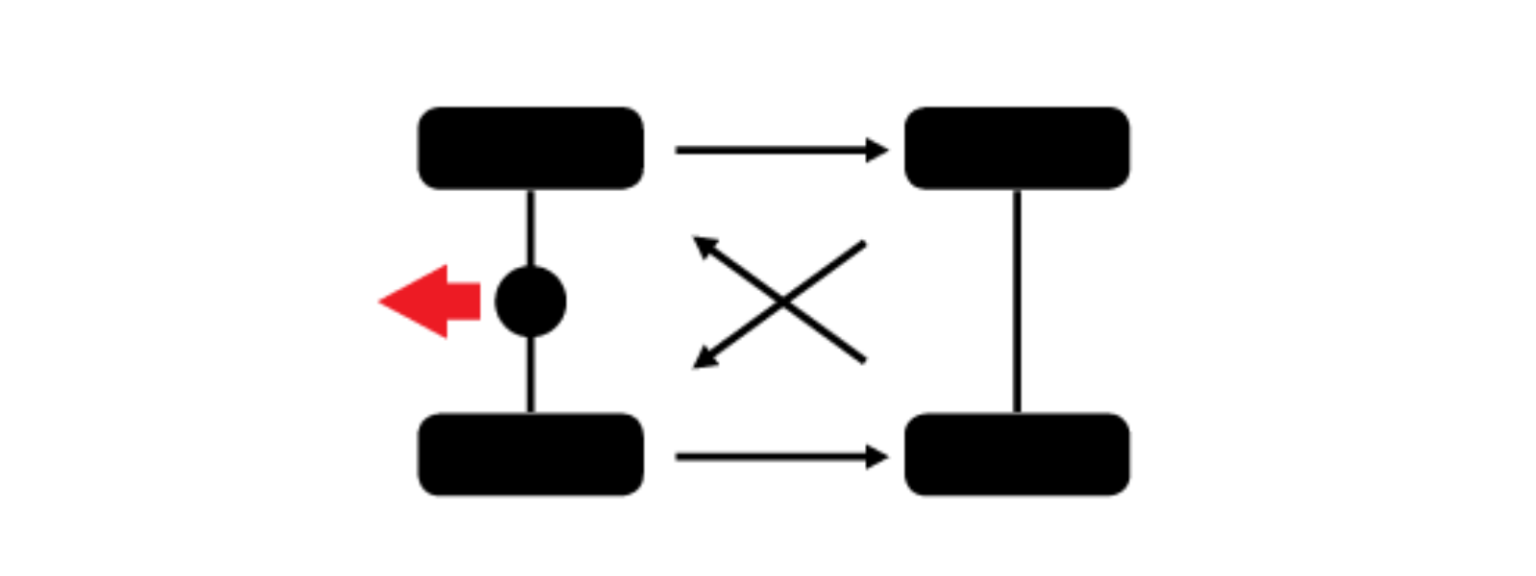
Tyre rotation is routinely repositioning your vehicle’s tyres in specific patterns from front to back or side to side and is an important element of tyre upkeep and safety.
WHAT IS TYRE ROTATION?
Tyre rotation means to periodically change the position of each of the tyres on your vehicle. You should rotate your tyres as recommended by the vehicle manufacturer.
Rotating your tyres regularly gives you a good opportunity to visually inspect your tyres for damage, check the air pressure, have them rebalanced if you’re noticing any vibration and check the tread depth.
WHY IS TYRE ROTATION IMPORTANT?
There are several reasons why tyre rotation is an important part of tyre care. By routinely rotating your tyres, wear is spread evenly across all four tyres, and their tread life is maximised. It is important to rotate new tires by 8,000 kms because deep, fresh tyre tread is more susceptible to uneven wear.
Having even tread wear keeps the tread depth on your tyres uniform, which can help keep traction and handling consistent across all four tyres. This will improve cornering and braking performance and allows better safety.
If your vehicle has all-wheel-drive, evenly worn tyres lower the stresses on the drivetrain, reducing wear on expensive drive components.
TYRE ROTATION PATTERNS
The tyre rotation pattern depends on the type of tyre you’re using, whether your vehicle is front, rear, all, or four-wheel drive, whether your tyres are directional or non-directional, whether or not your tyres are the same size on the front and rear of your vehicle, and whether you have a full-size spare that can be rotated through as well.
FOR TYRES THAT ARE OF UNIFORM SIZE AND NON-DIRECTIONAL:
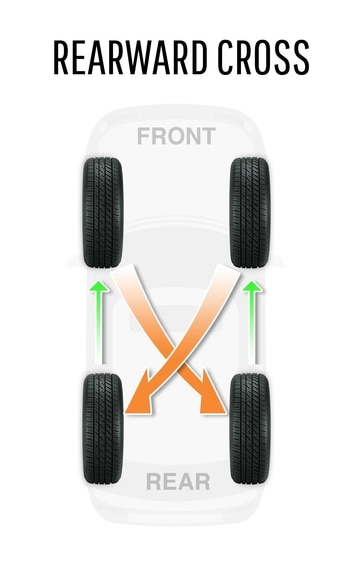
1. REARWARD CROSS
For vehicles that are 4-wheel, all-wheel, or rear-wheel drive, the rearward cross pattern is recommended. Rear tyres are moved to the forward axle and kept on the same side of the vehicle while the front tyres are moved to opposite sides of the rear axle.
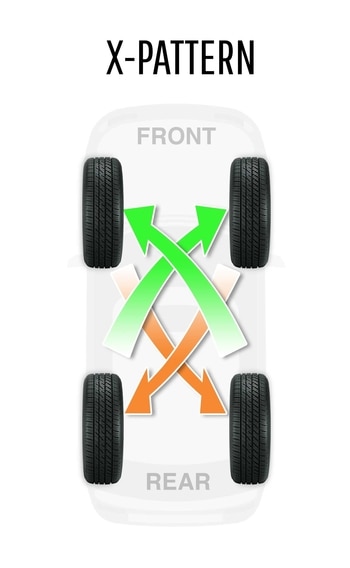
2. X-PATTERN
Recommended for front-wheel drive vehicles such as light-weight trucks and sedans, all tyres are moved diagonally, meaning tyres are switched from one axle to the opposite as well as being repositioned from one side to the other.
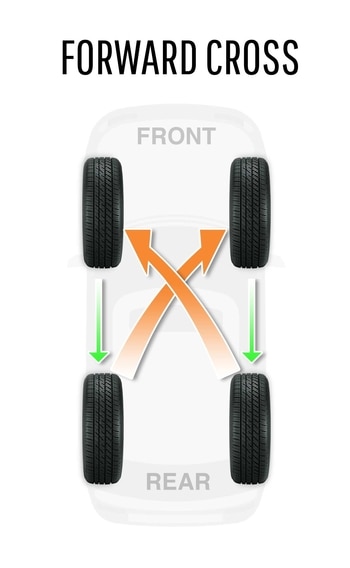
3. FORWARD CROSS
This is the most common pattern for front-wheel drive vehicles. The front axle tyres are moved directly back while the rear tyres are moved up diagonally to the opposite side of the front axle.
FOR TYRES THAT ARE OF UNIFORM SIZE AND NON-DIRECTIONAL WITH A FULL-SIZE SPARE TYRE:
In order to insure that all of the tyres on your vehicle have even tread wear, you’ll want to be sure to rotate your full-size spare tyre along with the other four. This is especially vital for all-wheel or 4-wheel drive vehicles where even small differences can put undue strain on your car’s drive train.
1. REARWARD CROSS (REAR-WHEEL OR 4-WHEEL DRIVE VEHICLES):
Both rear axle tyres move directly forward to the front axle while the spare ttre moves to the right side of the rear axle. The right front ttre moves diagonally back to the left side of the rear axle while the left front tyre becomes your new spare tyre.
2. FORWARD CROSS (FRONT-WHEEL DRIVE VEHICLES):
Rear tyres are moved diagonally to opposite sides on the front axle while the right front tyre becomes the new spare tyre. The spare tyre is positioned on the right side of the rear axle while the left tyre on the front axle is moved directly back into the left rear position.
FOR HIGH PERFORMANCE AND DIRECTIONAL TYRES:
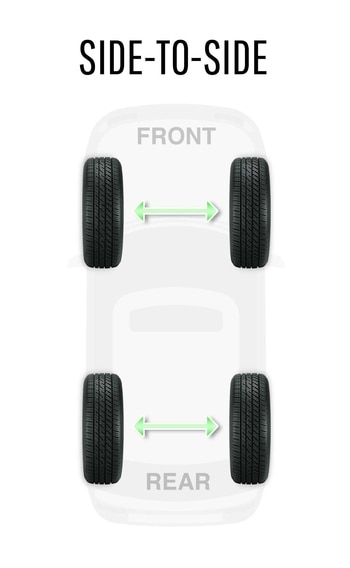
1. SIDE-TO-SIDE (FOR DIFFERENTLY-SIZED PERFORMANCE TYRES ON THE FRONT AND REAR AXLES)
All tyres are switched with their same-sized partner and remain on the same axle. The two rear tyres switch to the opposite side with one another while the two front tyres do the same.
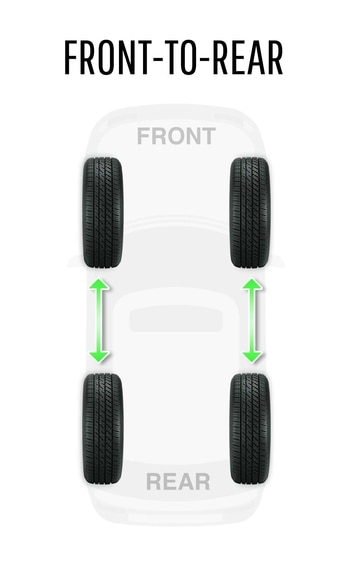
2. FRONT-TO-BACK (FOR DIRECTIONAL TYRES)
All tyres are moved from one axle to the other but remain on the same side of the vehicle. For example, the front left tyre is moved to the left side of the rear axle while the rear left tyre is repositioned on the left side of the front axle.

Comments are closed, but trackbacks and pingbacks are open.